What is a Community Land Trust?
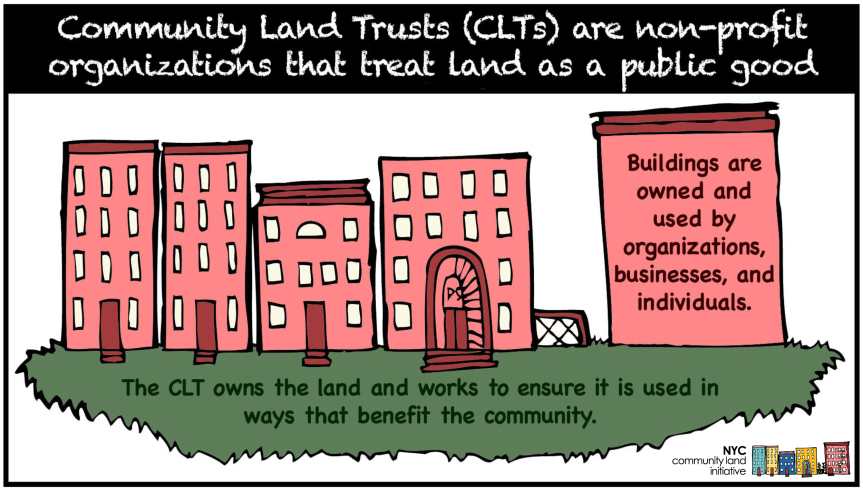
A community land trust (CLT) is a nonprofit organization that owns land on behalf of the community to keep housing permanently affordable.
Instead of selling land to the highest bidder, a CLT removes land from the speculative market and holds it in trust for long-term community benefit. Residents can own their homes or collectively care for their building, but the land underneath stays in community stewardship with the CLT. This keeps housing prices stable and protects neighborhoods from displacement.
In simple terms:
A community land trust makes sure land is used for people, not profit – today and for future generations
Why Collective Stewardship and housing stability over profit?

When land and housing are treated primarily as investments, prices rise, speculation increases, and long-time residents are pushed out. In neighborhoods like Koreatown and Central Los Angeles, this has meant displacement, overcrowding, and instability for working-class families.
Collective stewardship offers a different path.
By placing land in community trust and supporting cooperative stewardship, we shift housing away from short-term profit and toward long-term stability. Instead of maximizing resale value, we prioritize affordability, democratic governance, and intergenerational security. Residents make decisions together, create systems of care, and protect their homes from speculative market pressures.
Housing stability allows families to plan for the future. It strengthens schools, small businesses, and neighborhood relationships. It preserves cultural roots and community memory. It creates space for people to thrive rather than constantly struggle to stay.
Profit-driven housing benefits investors.
Collective stewardship benefits neighbors.

Permanently Affordable Rental Housing Units
While BVCLT’s goal is to empower communities with collective pathways to own and govern their buildings, we do not make that decision for tenants. Housing cooperative development and shared governance require time, commitment, and sustained participation. Not all residents are interested in prioritizing that process, and we respect that.
We also prioritize housing stability and collective decision making over ownership itself. Ownership is not the end goal. Long term stability, resident voice, and protection from displacement come first.
Traditional affordable housing providers typically secure funding that restricts rents for a limited period, often up to 55 years. After that term expires, units may convert to market rate.
In contrast, BVCLT ensures permanent affordability in perpetuity, with no expiration date. Residents in BVCLT homes always have the option, by their own choosing, to remain affordable rental tenants. Community ownership is a pathway available to them, not a mandate.
Limited Equity Housing Cooperatives
Homes are not individually owned by residents. Instead, residents collectively own a share of the entire property through a limited equity housing cooperative, commonly known as a co op, and receive the right to occupy their individual unit.
Each cooperative qualifies for a blanket loan based on the collective income generated by the rents within the property, rather than requiring each household to individually secure financing. One major advantage of this model is that residents do not need to qualify for a personal mortgage to buy into a limited equity housing cooperative, which is often one of the biggest barriers for very low income families. Down payments are also typically low compared to traditional homeownership.
With training and ongoing support from BVCLT, residents collectively own and manage the property, making decisions together and passing cost savings on to themselves. Cooperative members can build modest equity and savings over time, which may support future goals such as individual homeownership or local business development.
Residents who become members of BVCLT co ops typically have incomes between 40 percent and 65 percent of the area median income.

Beyond Housing

Community land trusts are not limited to housing, even though housing is BVCLT’s primary focus. A CLT can hold a wide range of community assets above the land so they remain community governed and protected from speculation. This can include community gardens, farmland, small businesses, commercial spaces, and other community serving uses.
The purpose of using a CLT structure is to ensure that residents have a direct voice in how land and buildings are used, and that the community collectively governs how a site is stewarded over time.
BVCLT has had the opportunity to acquire both a commercial site and a garden under this model, guided by resident decision making and long term community benefit.
